Friday, December 10, 2010

In Science Class . . . Week of 12/6

5th Grade: This week, the students have been studying digestion through reading, discussion and a video. Here's a diagram:


Of the structures shown above, students need to know the names and functions of the following:

Teeth: Used for grinding food into smaller bits
Saliva: Made in the mouth and used for wetting food and breaking it down.
Esophogus: Moves food from the mouth to the stomach
Stomach: Contains strong digestive acids for further breaking down food
Small intestine: Most nutrients are absorbed through the wall of the small intestine to the blood stream

For excretion, the students need to know the following structures:
Large intestine (colon): Condenses and dries solid waste
Rectum/anus: Used for excretion of solid waste
Kidneys: Clean blood in preparation for liquid waste excretion
Bladder: Stores liquid waste prior to urination
Lungs: Used to exhale carbon dioxide


4th Grade: Our students have been observing their terrariums. Our plants have germinated (sprouted) and are growing nicely in the science room. In particular, the barley has shot up and is now about 10-15 cm high. We have been working on measuring them, both inches and centimeters. 

In addition, students were also introduced to the concept of abiotic (nonliving) and biotic (living) factors that can influence living things. For example, in our terrariums, abiotic factors such as temperature, light, and space are very important.

We also have been studying the different living organisms in a typical North American forest ecosystem. Students put together basic food chains using cards with pictures. Next week we will begin transitioning to food webs.

Key questions:
  • What plants are growing in your terrarium? About how high are they? What unit of measurement are you using? (ie inches or centimeters)
  • What abiotic factors could be influencing the growth of your plants?
  • What is a food chain and what does it show? (It shows the transfer of energy in living things in an ecosystem)

Friday, December 3, 2010

In Science Class . . . Week of 11/29

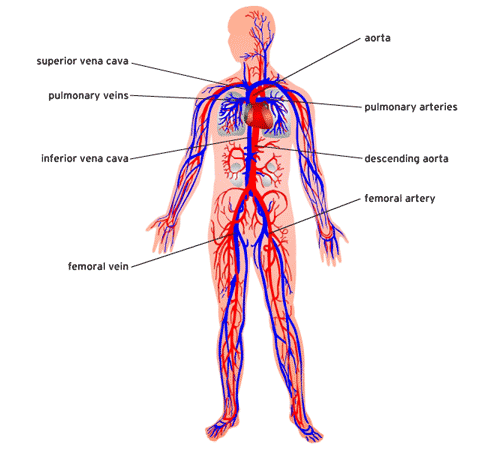
5th Grade: This week, the 5th grade students have started a new unit on living systems. They learned about cells and circulation through reading, discussion and video. Here is a diagram of the circulatory system:
The students do not need to know all of the names of the various arteries and veins; it is more important that they understand the main ideas:
  • What are cells? (Small units found in all living organisms) 
  • What do cells need to survive? (Water, food, gas exchange, waste disposal)
  • How do many animals, including mammals, get these requirements to the cells? (Through a circulatory system). 
  • What are the key components of human circulatory system? (Blood, heart, arteries, veins and capillaries)
  • How does the body respond to increased cell needs during exercise? (By increasing breathing and heart rate, the circulatory and respiratory systems can get more oxygen to cells).
  • Why do your veins appear blue? (They contain blood that has already "given up" it's oxygen to the cells, so the blood itself is blue. When you cut yourself, the blood immediately gets oxygen from the air, so blood from all cuts is red.)
  • How many chambers does the human heart have? (4. The right two chambers are responsible for pumping deoxygenated blood to the lungs, while the left two chambers are responsible for receiving oxygenated blood from the lungs and pumping it to the body. 
4th Grade: The fourth graders have also been starting our life science unit by setting up terrariums. The terrariums are made out of large lettuce containers, and early this week we planted seeds in soil in them. So far, we have some germination! Our radish plants are just beginning to poke out of the soil. During the next few weeks, we'll be monitoring these plants and using them as a basis for discussion on environmental factors (abiotic and biotic) and food webs.
Key questions to ask your child about this process: 
  • What did you plant in your terrarium? (Any combo of barley, peas, corn, and radishes)
  • What do you think will influence how your plants grow? (Space, light, temperature, availability of water and nutrients)
Just for a visual, here's a sample terrarium. Ours are not quite as sophisticated but the concept is the same!

Friday, November 19, 2010

In Science Class . . . Week of 11/15

5th Grade: We have been discussing local weather and water systems as we wrap up our earth science unit. The students will have a quiz on Monday, and will be bringing home a completed study guide today.
Key questions:
  • Where do our storms come from in CA? (Usually over the Pacific)
  • Where does our drinking water come from? (Much of CA depends on rain and snow that falls in the Sierra Nevada mountains. Various water transportation systems bring the water to the coastal areas.)
4th Grade: The students this week learned about fast versus slow geological changes, and we watched a video about volcanoes (which are relatively fast changes to the landscape). They will also have a quiz on Monday on erosion and weathering.
Key questions:
  • What are examples of "fast" geological changes? (Volcanoes, earthquakes, landslides)
  • What are examples of "slow" geological changes? (Many types of chemical and physical weathering, including freezing water, tree roots, etc)
  • What landforms did you learn about? (Meander, plateau, valley, canyon, delta, etc)

Friday, November 12, 2010

In Science Class . . . Week of 11/8

Because of the early dismissal, our science schedule has been a bit erratic! But here at the updates:

5th Grade: We have been working learning about weather maps using the internet. Students have been examining maps on www.weather.com. If you have some time at home, have your student show you the website - there are a ton on great features, including videos, a variety of maps, and pictures of current weather events from around the world. A sample weather map is pictured to the right!


4th Grade: The 4th graders have been studying erosion and deposition over the last few lessons. We have been using trays of sand to study how water changes landscapes. Last week, we looked at the landforms that result from water erosion (canyons) and this week, we've been looking at the landforms that form from deposition (like deltas). See below for pictures.

Samples of landforms resulting from erosion:
The Grand Canyon is an amazing example of a landform resulting from erosion on a huge scale. The river, over many years, has washed away rock, leaving behind a deep canyon. 


The ocean is a source of erosion as well. In this picture, you can see how the water has changed the rocks over many years.


Below is an example of deposition:

A delta forming where sediments are being "dropped" by the water.

Visual of the Water Cycle

Above is a great diagram of the Water Cycle, which is what we've been studying with the 5th graders.

Tuesday, November 2, 2010

In Science Class . . . Week of 11/1

5th Grade: This week in class, we'll be beginning of study of weather by studying weather maps, and then we'll be doing a reading about severe weather conditions. Key questions:
  • What symbols did you see on the weather maps, and what do they mean? ( H= high air pressure, L= low air pressure, etc)
  • Why does the California coast have more moderate temperatures than inland? (Because we are near the ocean, and the air over the ocean heats up much more slowly because the ocean itself does not heat up easily). 
  • Where do our storms in Berkeley come from? (Primarily from out over the Pacific Ocean)
4th Grade: We will continue our study of weathering and erosion. The students studied physical weathering last week, and we continued with a review of biological and chemical weathering of rocks early this week. Later in the week, we'll be working with our stream table to observe how water erodes sand and clay.  Key questions?
  • What do chemical and physical weathering have in common? (Both processes include the break down of rocks into smaller pieces. Physical weather can occur with water, wind, ice, other rocks, while chemical weathering includes a chemical reaction, like with acid rain.)
  • What is erosion? (When rocks get carried to new locations)

Monday, October 25, 2010

In Science Class . . .Week of 10/25

Happy Halloween!

5th Grade: This week, we'll be learning about the water cycle. The students have already studied condensation and evaporation, so these concepts should be familiar. We will be reviewing vocabulary and playing a game. There will be no class on Friday due the Halloween celebration. Key questions:
  • What is the water cycle? (The global water-recycling system that includes water in all three states - gas, liquid, and solid)
  • Where is most of the earth's water? (In the ocean as salt water. Only 1% of the earth's water is fresh and available to us to drink.)
  • As a water molecule, where did you "go" in the water cycle game? (Answers were vary - may include ground water, glacier, animal, ocean, clouds, river, lake, etc)
4th Grade:
This week, we'll be reviewing the rock cycle (see previous weeks' blog) and learning about the process of weathering by shaking pieces of granite and breaking them down to sand. If we have time, we'll also explore chemical weathering by placing limestone in vinegar. Key questions:
  • What is weathering? (The process by which larger rocks are cracked and broken down into smaller pieces).
  • What happened to your granite when you shook the jar? (It broke into smaller pieces, so as small as sand.)
  • Where can we see weathering in action around us? (Answers may vary - examples include cracked pavement, broken rocks, sand at the beach, etc)

In Science Class . . . Week of 10/18

Sorry for the delay! It was a super busy week, as I attended the CA Education Conference in Sacramento.

5th Grade: Last week, the 5th graders explored the properties of air pressure using syringes, tubing and clips. By pushing the air back and forth, we determined that air is made of matter and does take up space. The students also did a reading that explained how the pressure and density of air changes with elevation.
Key questions:
  • What happened when you put a clip on the end of the tube and why? (The plunger to the syringe couldn't go in far because the air was trapped.
  • Why did the plunger of one syringe go out when you pushed the other connecting syringe in? (The air pushed the plunger out when we pushed on the other end.)
  • Is air pressure higher or lower on the top of a mountain? Why? (The air pressure is lower because the air molecules are spread out more. This is also why it's harder to breathe at elevation.)
4th Grade: Last week, the 4th graders continued their study of the property of minerals, exploring cleavage, luster and color of the streak. We also introduced the rock cycle and the three types of rock - sedimentary, igneous and metamorphic. Key questions:
  • What are metamorphic rocks (Rocks formed from heat and pressure, ex marble)
  • What are igneous rocks? (Rocks from the mantle of the earth, either cooling just below the surface of the earth or coming out of a volcano and cooling on the surface. Examples we've looked at include granite, obsidian.)
  • What are sedimentary rocks? (Rocks formed from small bits and pieces of other rocks, like sandstone or limestone. Often formed at the bottom of bodies of water.)
  • What role do erosion and weathering play? (The are the processes by which rocks break down into smaller bits, becoming sand or, if compressed, a sedimentary rock.)

Friday, October 15, 2010

In Science Class . . . Week of 10/11

5th Grade
This week, the students performed an experiment that compared how water and soil respond to the energy from the sun. We took cups of soil and water outside, and recorded temperatures of the materials in the sun every few minutes for 15 minutes, then moved them to the shade and recorded temperatures every few minutes there. This experiment will help students when we begin our study of weather and climate in a few weeks.  On Monday, the students will create line graphs of their data, and we'll discuss independent vs. dependent variables. Key questions:     
  • What did you discover about how soil and water heat? (Soil heats up and cools down much more quickly, while water is a "heat sink," meaning that it takes an ton of energy to warm it up.)     * What was the dependent variable in the experiment? (Temperature, because it depends on the time the material was in the sun. )     
  • What variables did we control? (Amount of materials used, time in the sun/shade, type of thermometer used, etc)
4th Grade
This week, the 4th graders looked more closely at the properties of minerals. We have already studied color and hardness in previous experiments. This week, we examined luster, cleavage and streak, and worked on using a mineral property chart to identify unknown minerals. Key questions:
  • What is luster? (It is the sheen on the mineral - ether metallic or nonmetallic)
  • What is cleavage? (Whether or not a mineral breaks with flat surfaces. Calcite is an example of a mineral with cleavage.)
  • What is streak and why is it important to geologists? (The color of the mark the mineral makes when you scratch it on a tile. It is useful because some minerals can be different colors, but the streak on the tile is always the same color.)

Monday, September 27, 2010

In Science Class . . . Week of 9/27

5th Grade: In 5th grade science this week, we'll be wrapping up our evaporation experiments and graphing our results. Students will practice using syringes and graduated cylinders to measure water volume.  Key questions:
  • How did you measure the volume of the water in the cups? (We used a syringe to put the water into a graduated cylinder.)
  • Where in the classroom did water evaporate most quickly? (Depends on group, but likely by 007's terrarium, because the air temperature was higher due to the heater.)
  • Where did it evaporate the slowest? (On the floor, in the cupboard, etc where air temperatures were lower)
4th Grade: This week, we'll be continuing our investigations into the properties of minerals. In particular, we will be looking at calcite, which reacts with acid to form CO2 gas (bubbles). We'll be testing which rocks contain calcite by putting them in vinegar. Key questions:
  • What makes calcite special? (It reacts with acid to form gas bubbles)
  • Which rocks contained calcite? How do you know? (Limestone and marble, because they bubbled. Sandstone had air bubbles come off of it because it is porous, but it didn't continue to bubble so it does not contain calcite.)

Monday, September 20, 2010

In Science Class . . . Week of 9/20

5th Grade: This week, the students will be focusing more on evaporation and recording data. We will examine our paper towel experiment, and then design an experiment to investigate how different locations in the room affect evaporation. Key questions:
  • What happened to the scale with the paper towels? (The paper towel with out the lid dried, meaning the water evaporated. The paper towel with the lid did not dry because the water was contained, though there was some condensation on the inside of the cup. The scale tipped toward the side with the lid because it still contained water, whereas the water on the other paper towel had escaped into the atmosphere.)
  • Where did your group place the cups with water? What predictions did you make? Which cups will have the highest evaporation rates?
4rh Grade: Students will begin to examine the mineral property of hardness by investigating which minerals can be scratched by certain tools. A mineral that can be scratched by a fingernail is "softer" and thus lower on the Mohs hardness scale, which goes from 1-10. (A diamond is a 10, talc is a 1.) Key questions:
  • What mineral was the hardest and how did you know? (Quartz, because it could not be scratched by any of the tools)
  • What mineral was the softest? (Gypsum, because it could be scratched by the nail, the paper clip and the fingernail, and you can see bits of it coming off in the form of a white powder.)
  • Why do geologists test for hardness? (It helps them identify minerals better. Color is not enough to identify minerals most of the time.)

In Science Class . . . Week of 9/13

5th Grade: This week, we wrapped up our solar system section by reviewing key concepts on the planets (see previous post) and watching a video. We have moved on to discussing evaporation as part of our focus on earth processes. The students observed a demonstration that involved putting two wet paper towels on a scale, with one side being covered by a lid. Key questions

  • Where do you see evaporation in daily life? (When things "dry up" like laundry, puddles on the sidewalk, hair after a shower, etc)
  • What did you predict would happen with the scale and the wet paper towels? Would both paper towels dry?
4th Grade: This week, the students broke apart their fake rocks and separated based on "minerals." We then put the gray material in water to separate in further.  The second class of the week, students observed real mineral samples and recorded observations.

  • What types of minerals did you find in the fake rocks? (Blue, red, white, and gray, the last of which we were able to separate further and appeared in layers in our vials filled with water.)
  • What were some of the words you used to describe the mineral samples? (Rough, smooth, shiny, dull, transparent, green, white, etc)

Friday, September 10, 2010

Welcome to Science! Weeks of 8/31 and 9/6

Hello, everyone, and welcome to a new year of science at BAM! I am very excited to back at BAM, teaching a subject I love. On this blog, I'll update you on our lessons and topics and include questions you can ask your 4th and 5th grader to reinforce science concepts (and spark conversation)!  If you have questions about any of the following or anything related to science education at BAM, please contact me at caitlin_jenkins@berkeley.k12.ca.us.

Both 4th and 5th graders did a sensory/observation activity last week. I passed around brown paper bags with common household objects in them. Instead of looking in the bag, students had to use their sense of touch and smell to write descriptive words and make a guess as to what the object was. The learning goals were to work on our observation skills, scientific language and to introduce students to the scientific method. Questions to ask your student: What were the objects? How did you know? What words did you use to describe them?

5th Grade: This week, the 5th graders started their investigations in the solar system. Students worked with cards with each of the components of our solar system on them, including comets, planets, satellites, asteroids and the sun. On the back of each of these cards is important information about the object's mass, diameter, composition, distance from sun and temperatures. Today, we will work on sorting and ordering them by distance from the sun, size, temperature, etc.  Key questions to ask:
  • What is the order of the planets? (Mercury, Venus, Earth, Mars, Saturn, Jupiter, Uranus, Neptune).
  • What is the difference between the inner and outer planets? (Inner planets are rocky and solid, while outer planets are made of gas.)
  • What is the largest planet? (Jupiter) The smallest? (Mercury)
  • What planets have very high surface temperatures? (Those closest to the sun, though Venus is hotter than Mercury because it has an atmosphere that helps it retain heat.)

4th Grade: This week, the 4th graders have been practicing their measurement and observation skills on "mock rocks." These are fake rocks that I baked in my oven! We will be working with real rocks and minerals later in the unit, but are using these mock rocks at this time so that we can easily see "minerals" and separate them (which we will do next week). This week, students measured the diameter, circumference, depth and mass. We discussed choosing the appropriate tool for each task and including the correct unit of measurement. Key questions to ask students:
  • What did your rock look like? (Gray, with blue and red spots. Under the hand lens, you can see grains of something white and shiny.)
  • How did you measure mass? (We used a balance with cups on either side and gram pieces.)
  • What tool did you use to measure the diameter (how far across), circumference (around) and depth (thickness)? (We used a measuring tape that was a meter long.)
  • What are other tools you can name that measure the world around us? (Yard sticks, rulers, thermometers, measuring cups for baking, scales, etc)

Thursday, April 22, 2010

I almost forgot . . . .

Happy Earth Day!

In Science Class . . . Week of 4/19

5th Grade: This week, we again are headed back in time to 4th grade. The students have been reviewing the 4th grade earth science unit. We've investigated the properties of minerals, including color, streak, cleavage, and hardness. On Friday, we'll bring out the stream tables that allow students to experiment with water and sand, observing erosion and land formations. Key questions: What is the difference between a rock and a mineral? What affects does water have on land? What are examples of "quick" geologic changes and "slow" geologic changes?

Ms. Klein's class also had the benefit of some visiting scientists through the Community in the Classroom program. We learned all about various energy types, including gasoline, batteries, and hydrogen technology. The scientists did several engaging demonstrations, and the presentation tied in quite well to our physical science unit from the fall. It was fun to see the students show and apply their knowledge to a new topic! I will continue to work to see if we can get other presenters to come to other classes at BAM to discuss current research and supplementary topics.

4th Grade:  This week, we've got some live critters in room 205! We learned about the Monterey Bay food chain on Monday, and then on Wed, we had our initial observations of isopods ("rolly polly") and beetles (insect).  We will be studying these animals over the next couple classes, investigating what environmental factors (light, moisture) are preferable for them. Our terrariums are still looking beautiful (and are a bit crowded) so we will be sending the plants home next week with students. If you would like some information about how to help them continue to grow in your house or garden, please let me know!
Key questions: What are the differences between isopods and beetles? How are they similar? How did they respond to being in the cup? Why do you think they did that?

In Science Class . . . Week of 4/12

5th Grade: In preparation for the upcoming CST, we've taken the BAM time machine back to 4th grade, reviewing the principles of magnetism and electricity. We explored the way magnets attract and repel, and built several types of circuits (parallel and series). We also created an electromagnet to pick up washers. Key questions: What is the difference between a series and parallel circuit? What items do we need to build and electromagnet? What is the benefit of an electromagnet? What objects do permanent magnets stick to? What objects can become a temporary magnet?

4th Grade: The 4th graders have been been exploring various interactions between organisms and their environment! The corn, peas, and radishes in our terrariums are growing like crazy thanks to the warm and sunny conditions in the science room. We also have simultaneously been examining food chains, and the flow of energy throughout an ecosystem. Key questions: What tools have we been using to monitor our plants? What environmental factors can affect their growth? Describe a typical marine and forest food chain. What is a herbivore? Carnivore? Omnivore? Producer? Consumer? 

Tuesday, April 6, 2010

In Science Class . . . Week of 4/5

5th Grade: The fifth graders set up an experiment with celery, a vascular plant, on Monday. They designed their own experimental question and hypothesis related to water uptake. This is part of our unit on living systems, which up until this point, has focused on animal systems of digestion, circulation, excretion and respiration. Later this week, we will be starting test prep to review concepts and strategies in preparation for the state science test in early May. Key questions: What was your experiment? What variable are you investigating? What did you predict would occur and why? 

4th Grade: This week, we will be setting up our terrariums, which will include soil, water and seeds of radishes, peas and corn. Hopefully we will be seeing sprouts by next week! Keep your fingers crossed! These terrariums are mini-ecosystems and will eventually include beetles and isopods.We will be making observations of changes over the next couple weeks. Later in the week, we will be discussing seeds and their role in plant reproduction.  Key questions: What were the living and nonliving environmental factors in your terrarium? How did you plant them? What do you predict you will see occur over the next few weeks? Why are seeds important? How can they move to new locations?

Wednesday, March 24, 2010

In Science Class . . . Week of 3/22

5th Grade: The students have been reviewing human systems content and vocabulary through some games and activities. We will be moving on to plant systems hopefully by the end of the week. If not, we will start on the Monday after Spring Break!

4th Grade: On Monday, the 4th graders read about fast landform changes that have happened recently, and saw some pretty incredible pictures! We then used our stream tables to see how a flood (excess water) affected erosion and deposition rates. We found the with a lot of water pouring over our sand and class, more material was picked up and washed away, thus having higher erosion and deposition rates. Key questions: How did the flood change erosion and deposition? How do you know? What did you see in your stream table? What are some other fast landform changes that you read about besides floods?

In Science Class . . . Week of 3/15

5th Grade: This week, the students continued their study of human systems, including the circulatory, respiratory, digestive and excretory system through readings, video and discussion. Key questions: What is the purpose of the blood and heart? What do the lungs do? What do cells need? (gas exchange, food, water, waste disposal) How do the digestive and excretory systems work together? Why are they important?

4th Grade: This week the 4th graders continued their study of land formation. They discussed slow and quick geological changes, with a focus on erosion as an example of slow change, and volcanoes as a quick one. Key questions: Name three slow geologic changes and three quick ones. What landforms result from these changes?

Note: Please send in plastic lettuce containers if you have them so we can start our terrariums after break!

Friday, March 12, 2010

In Science Class . . . Week of 3/8

5th Graders: The students are starting a new unit on living systems. Our first investigation has been exploring what all living cells need (food, water, waste disposal, gas exchange), and looking at the way the human body provides cells with those through the circulatory and respiratory systems. The students have been reading, asking questions, and watching a video about these concepts. We also have been having fun measuring our pulse, and experimenting with how exercise affects it! Key questions: What do living cells need? What is the purpose of the circulatory system and the respiratory system? What does the left side of the heart do? The right side? Why is your blood blue in some areas and red in others?

4th Graders: The fourth graders have been continuing their investigations of how water and other natural forces can shape the land. We spent Monday experimenting with sand, clay and water, and watching erosion take place. Later this week, the students read about and studied pictures of both erosion and deposition. Key questions: When rock is washed away, what is this process called? How can the rock in the mountains become sand on the beach? Why did the clay move further than the sand in our stream tables? What is the area of deposition at the mouth of the river called?

Wednesday, February 10, 2010

In Science Class . . . . Week of 2/8/10

5th Grade: The fifth graders are moving on air pressure, atmosphere and resulting effects on weather. They have been experimenting with syringes, tubes and plastic bottles to investigate how air moves and different pressures are created.  Key questions: What happened with your syringes and tubes? Why did the plastic bottle collapse? Where are earth is the highest atmospheric pressure? The lowest?

4th Graders: The 4th graders are continuing with mineral identification and practicing organizing their information into tables. They are testing known minerals for hardness, streak, luster, cleavage and magnetism.

Tuesday, February 2, 2010

In Science Class . . . Week of 2/1

Sorry for the delay in getting posts up, everyone! It's been a busy couple weeks with field trips and such.

5th Grade: The 5th graders have been studying the water cycle and weather over the past couple weeks. We have observed and discussed water vapor, condensation, and evaporation. This past week, we worked on understanding weather maps using various websites. This week, we are moving on to atmospheric pressure. Key questions: What is high and low pressure? How does wind form? What is a cold front and what weather does it produce? What is a warm front and what weather does it produce? Where can you see examples of condensation of water vapor in the air?

4th Grade: We have been working on mineral identification for the past couple weeks, investigating mineral's streak, luster, magnetism, and hardness. This week, the students will be working on putting this information into a table to organize the information, and comparing it to the properties of known minerals to help with identification. Key questions: What is the difference between a rock and a mineral? How can you tell minerals apart? What happens when you put calcite in an acid, like vinegar?

Wednesday, January 6, 2010

In Science Class . . . Week of 1/4

5th Grade: In preparation for our trip to the Marin Headlands, the 5th graders will be reviewing evaporation and it's role in the water cycle. We are examining water distribution on earth, and sources of fresh water for human consumption. Our classes this week will consist of some demonstrations, reading, and a water cycle game. Key questions: Where is most of water on earth found? What are some locations that fresh water is found? How does temperature affect weather?

4th Grade: The fourth graders will learn about calcite, a very common mineral. On Monday, they tested four rocks (limestone, basalt, marble, sandstone) for calcite by placing them in a weak acid, vinegar. When calcite comes in contact with acid, it reacts to form carbon dioxide bubbles. Later in the week, the students will learn about where calcite is formed, and how rocks (like marble) can be used in buildings. Key questions: How did you know limestone and marble contained calcite? Why can't we see the calcite itself in the rock? What other types of rock contain calcite? How do geologists test for calcite in the field?