Friday, December 10, 2010

In Science Class . . . Week of 12/6

5th Grade: This week, the students have been studying digestion through reading, discussion and a video. Here's a diagram:


Of the structures shown above, students need to know the names and functions of the following:

Teeth: Used for grinding food into smaller bits
Saliva: Made in the mouth and used for wetting food and breaking it down.
Esophogus: Moves food from the mouth to the stomach
Stomach: Contains strong digestive acids for further breaking down food
Small intestine: Most nutrients are absorbed through the wall of the small intestine to the blood stream

For excretion, the students need to know the following structures:
Large intestine (colon): Condenses and dries solid waste
Rectum/anus: Used for excretion of solid waste
Kidneys: Clean blood in preparation for liquid waste excretion
Bladder: Stores liquid waste prior to urination
Lungs: Used to exhale carbon dioxide


4th Grade: Our students have been observing their terrariums. Our plants have germinated (sprouted) and are growing nicely in the science room. In particular, the barley has shot up and is now about 10-15 cm high. We have been working on measuring them, both inches and centimeters. 

In addition, students were also introduced to the concept of abiotic (nonliving) and biotic (living) factors that can influence living things. For example, in our terrariums, abiotic factors such as temperature, light, and space are very important.

We also have been studying the different living organisms in a typical North American forest ecosystem. Students put together basic food chains using cards with pictures. Next week we will begin transitioning to food webs.

Key questions:
  • What plants are growing in your terrarium? About how high are they? What unit of measurement are you using? (ie inches or centimeters)
  • What abiotic factors could be influencing the growth of your plants?
  • What is a food chain and what does it show? (It shows the transfer of energy in living things in an ecosystem)

Friday, December 3, 2010

In Science Class . . . Week of 11/29

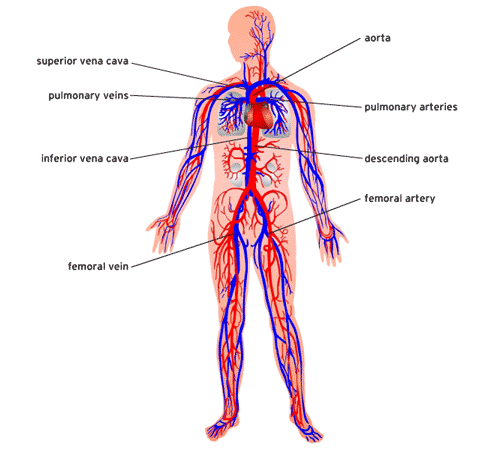
5th Grade: This week, the 5th grade students have started a new unit on living systems. They learned about cells and circulation through reading, discussion and video. Here is a diagram of the circulatory system:
The students do not need to know all of the names of the various arteries and veins; it is more important that they understand the main ideas:
  • What are cells? (Small units found in all living organisms) 
  • What do cells need to survive? (Water, food, gas exchange, waste disposal)
  • How do many animals, including mammals, get these requirements to the cells? (Through a circulatory system). 
  • What are the key components of human circulatory system? (Blood, heart, arteries, veins and capillaries)
  • How does the body respond to increased cell needs during exercise? (By increasing breathing and heart rate, the circulatory and respiratory systems can get more oxygen to cells).
  • Why do your veins appear blue? (They contain blood that has already "given up" it's oxygen to the cells, so the blood itself is blue. When you cut yourself, the blood immediately gets oxygen from the air, so blood from all cuts is red.)
  • How many chambers does the human heart have? (4. The right two chambers are responsible for pumping deoxygenated blood to the lungs, while the left two chambers are responsible for receiving oxygenated blood from the lungs and pumping it to the body. 
4th Grade: The fourth graders have also been starting our life science unit by setting up terrariums. The terrariums are made out of large lettuce containers, and early this week we planted seeds in soil in them. So far, we have some germination! Our radish plants are just beginning to poke out of the soil. During the next few weeks, we'll be monitoring these plants and using them as a basis for discussion on environmental factors (abiotic and biotic) and food webs.
Key questions to ask your child about this process: 
  • What did you plant in your terrarium? (Any combo of barley, peas, corn, and radishes)
  • What do you think will influence how your plants grow? (Space, light, temperature, availability of water and nutrients)
Just for a visual, here's a sample terrarium. Ours are not quite as sophisticated but the concept is the same!