Friday, April 1, 2011

In Science Class . . . Week of 3/28

5th Grade: This week in science, we have been looking at chemical reactions! During a chemical reaction, a mixture of chemicals changes to produce new substances. We did several chemical reactions on Monday and observed changes.  The evidence we say of a chemical reaction included a color change, a temperature change and/or production of a gas (bubbles). (A common chemical reaction that produces a gas is mixing baking soda and vinegar. )  On Wednesday, we dived into atoms and molecules and looked briefly at the periodic table. Student should understand that, in a chemical reaction, the atoms of the reactants rearrange to form new molecules (and thus substances).

Key questions:
  • What is an atom? (The smallest particle of matter)
  • What is a molecule? (Two or more atoms bonded together)
  • Why are there so many different substances on Earth when we only have about 90 naturally occurring elements? (The atoms can combine in infinite arrangements)
  • What happens in a chemical reaction? (The atoms rearrange to form something new).
  • What are common pieces of evidence for chemical reactions? (Change in color, change in temperature, bubbles)

4th Grade: This week the students detected magnetic fields using compasses, iron filings, and washers. We hid magnets in small boxes, and had other students try to find them using our tools. We also made our own compasses using straws, thread and a steel pin. By rubbing the magnet on the pin, we induced magnetism. Our pin then had poles and had it's north pole point north (as our Earth's north magnetic pole is actually a south magnetic pole.)

Key Questions:
  • Why did your tools work to find the magnet? (All are iron, and can be used to detect magnetic fields)
  • How did you make your compass?


Have a great vacation, everyone!

Wednesday, March 23, 2011

In Science Class . . . Week of 3/21

Fun Event: This Thursday, Berkeley Public Education Foundation will host a free Lawrence Hall of Science Night. It will be from 6-8:30 pm on Thursday, March 24. For more info, go to http://www.bpef-online.org

5th Grade: This week, we implementented our plans for separating a dry mixture of gravel, power and salt. Most groups realized that to separate the powder and salt, they needed to add water so the salt would dissolve and thus pass through a coffee filter (unlike the powder). Because it dissolves in water, salt and water together are an example of solution.

On Wednesday, students saturated two solutions - one of kosher salt and water, and one of Epsom salt and water. To saturate it means to dissolve as much salt in the water as possible. Students found that 50 ml of water could hold about 10-15 grams of salt, while the same amount of water could hold 40+ grams of Epsom salt. The idea behind this is that solubility is a property that distinguishes different chemicals.

On Friday, we'll be identifying a mystery substance based on it's solubility! In the week before spring break, we'll be looking at chemical reactions.


4th Grade: This week, the students performed an experiment to measure how magnetism decreases based on the distance between magnets. We also used a hanging magnet to detect the magnetic field of the earth! (All N poles of the magnets faced north, because our "North Pole" is actually a south magnetic pole and opposite poles attract!)

Friday, March 18, 2011

In Science Class . . . Week of 3/14

Thanks for a great Family Science Night! So wonderful to see so many students and families there. Thanks for your support of science education!

5th Grade: The students have started a new unit entitled "Mixtures and Solutions." We've practiced and discussed different ways of separating mixtures (which are two or more things mixed together). This week, we are investigating solutions, which is a type of mixture where the solid dissolves. We made a salt water solution, then separated it by evaporation.
Key Questions:
  • What is a mixture? What are some examples?
  • What is a solution? What are some examples? How do you separate solutions?

4th Grade: The students have also started a new unit on magnetism and electricity. This week, we spent a lot of time investigating which objects will stick to a magnet (objects made of iron). We also will be investigating the property of poles and the concepts of "attract" and "repel."

Key Questions:
  • What objects stuck to your magnet? Which did not?
  • What happens when you bring two magnets together? What if you flip one the other way?

Sunday, February 27, 2011

In Science Class . . . Week of 2/28

Hi, everyone! So sorry for the delay in blog posts - I have been on the overnight outdoor science field trips with both schools, as well as being swamped with grading and report cards. But here's the update:

5th Grade: 5th graders wrapped up their Living Systems Unit last week and took a quiz. Those graded quizes will be coming home with your student this week. We started our new unit, called "Mixtures and Solutions." Our first experiment had us making mixtures of a liquid (water) and various solids (gravel, powder, salt). A mixture is any combination of substances (either liquid, solid or gas) that can be separated. In class, we separated the water/gravel mixture using a mesh screen. The powder/water mixture could be separated using a coffee filter. Because the salt dissolved in the water, it is a special type of mixture called a solution. We will be looking at this further over the next couple weeks.

Also, the 5th graders will be planning stations for Family Science Night, happening on March 9 at 6:30. We'll be putting these together over the next few classes, and hopefully at least a few students from each group will be able to attend in the evening and show off their experiment.  I am also in need of a few more adult volunteers to help pull this off, so please contact me as soon as possible at caitlin_jenkins@berkeley.k12.ca.us if you are able to help! Thanks!


4th Grade: The 4th graders took a brief quiz last week on environmental preference, food webs, and biotic and abiotic factors. These have been graded and will be going home this week with your student. Most students did quite well! We are wrapping up our Environments unit this week with a study of brine shrimp. We'll be investigating the range of tolerance of salt concentrations for our brine shrimp to hatch!

Friday, January 28, 2011

In Science Class . . . Week of 1/24

5th Grade: This week in science, we've continued our learning about how plants make energy (and gain mass) and how other organisms use that energy. We did an experiment with yeast. By giving the yeast sugar (in the form of crumbled up Chips Ahoy cookies), they became active and started cellular respiration. This process produces carbon dioxide as a waste product, which caused our bags of yeast and warm water to puff up! We used a tool to measure that gas produced as well as the amount of gas produced by the control experiment (no cookies), which was zero in most cases.
Key questions to ask your student:

  • What organisms make their own energy? How can we tell that they are making energy? (Gain mass, grow)
  • In the experiment with yeast, how did we know that the yeast were burning sugar? (They produced carbon dioxide as a waste product)
  • Can you think of other organisms that produce carbon dioxide as a waste product of cellular respiration? (Most animals, including humans!)
4th Grade: This week, we have focused entirely on designing experiments to determine what sort of environment our beetles and pill bugs prefer. We placed the animals in runways with two types of conditions and watched to see which condition they moved to. Early in the week, we examined sunlight versus darkness and later in the week, we had the animals choose between dry and moist soil.
Key questions:
  • What abiotic factors can influence the isopods and beetles? (amount of light, temperature, amount of moisture, soil quality, etc)
  • What environments did your isopods prefer? (They prefer dark, moist environments)
  • What environments did your beetles prefer? (They preferred dark environments, but didn't seem to have a preference about soil moisture.)
  • What other experiments could you set up to explore environmental preference? (Answers may vary, but we discussed in class exploring temperature, food, and soil type preferences)

Friday, January 21, 2011

In Science Class . . . Week of 1/17

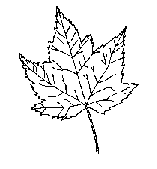
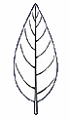
5th Grade: The 5th graders have been wrapping up our study of vascular plant systems. We've done some reading about vascular plants this week, and today, we'll be studying different vein patterns in leaves we find around the school yard. Here are some examples:

Palmate:
Pinnate:

Parallel:

Key Questions:
  • How do vascular plants get water and sugar to cells? (Xylem transports water up from the roots, while phloem transports it downward to other cells. Both xylem and phloem are part of "veins" that we see on leaves.)
  • What leaf patterns did you see in your leaves that you collected?
4th Grade: The fourth graders are starting to work with living organisms. Besides the class gecko, we now have a mini aquatic ecosystem. Our fish tank includes goldfish, pond snails and plants. The plants provide oxygen to the water and the snails are cleaning up after the goldfish, so it's a nice balance!  We also have started our observations of live beetles and isopods.  Here are some pictures for reference:

Darkling Beetle:

Isopod:


This week, our focus has been on simple observations on behavior and physical appearance. In the next few weeks, we'll use the critters to explore environmental preference.
Key Questions:

  • What did you notice about your isopods and beetles? How were they similar? How were they different?

Friday, January 14, 2011

In Science Class . . . Week of 1/10

Hi, everyone! Happy New Year! Apologies for not getting this out to you last week. We had a major power outage during the time I normally update the blog! Anyway, here's what we have been working on:
4th Grade: The fourth graders have been reviewing food webs and studying the different types of elements that make up an ecosystem. We played a game called "Who am I?" where students had to guess what part of the ecosystem they were (written on a card on their backs) by asking others yes and no questions.  Key questions:
  • What did you have on your card? Was it a consumer, producer, decomposer or abiotic factor?
  • What provides energy to most food webs? (Producers, usually plants or, in aquatic ecosystems, phytoplankton)

5th Grade: We've just wrapped up our human body systems and have started looking at the ways plants get energy, water and gas to their cells. This week, we've been experimenting on celery. We set up an experiment to see which type of celery uses more water - celery with leaves or celery without leaves. Students also got to put red food coloring in the water so that we could track the flow of water up the stem and into the leaves. Here are some key questions:
  • What do plant and animal cells have in common? (All need food, water, gas exchange and waste disposal)
  • How do vascular plants transport water? (There are tubes in vascular plants called xylem that bring water from the bottom up into the leaves. These tubes turned red in our celery experiment due to the red water we used.)
  • What would be analogous in the human body to xylem in plants? (Probably our circulatory system of veins and arteries, though we obviously have a heart that pumps it around, while plants depend on evaporation out of the leaves to draw water upwards.)
  • What did you find from your experiment? (Celery with leaves used more water. This is because the evaporation out of the leaves "pulls" water molecules from below. )
Here's a nice cross section photo of what we worked on. This photo also includes some celery where blue food coloring was used. We only used red, but using other colors would be a great at-home project!